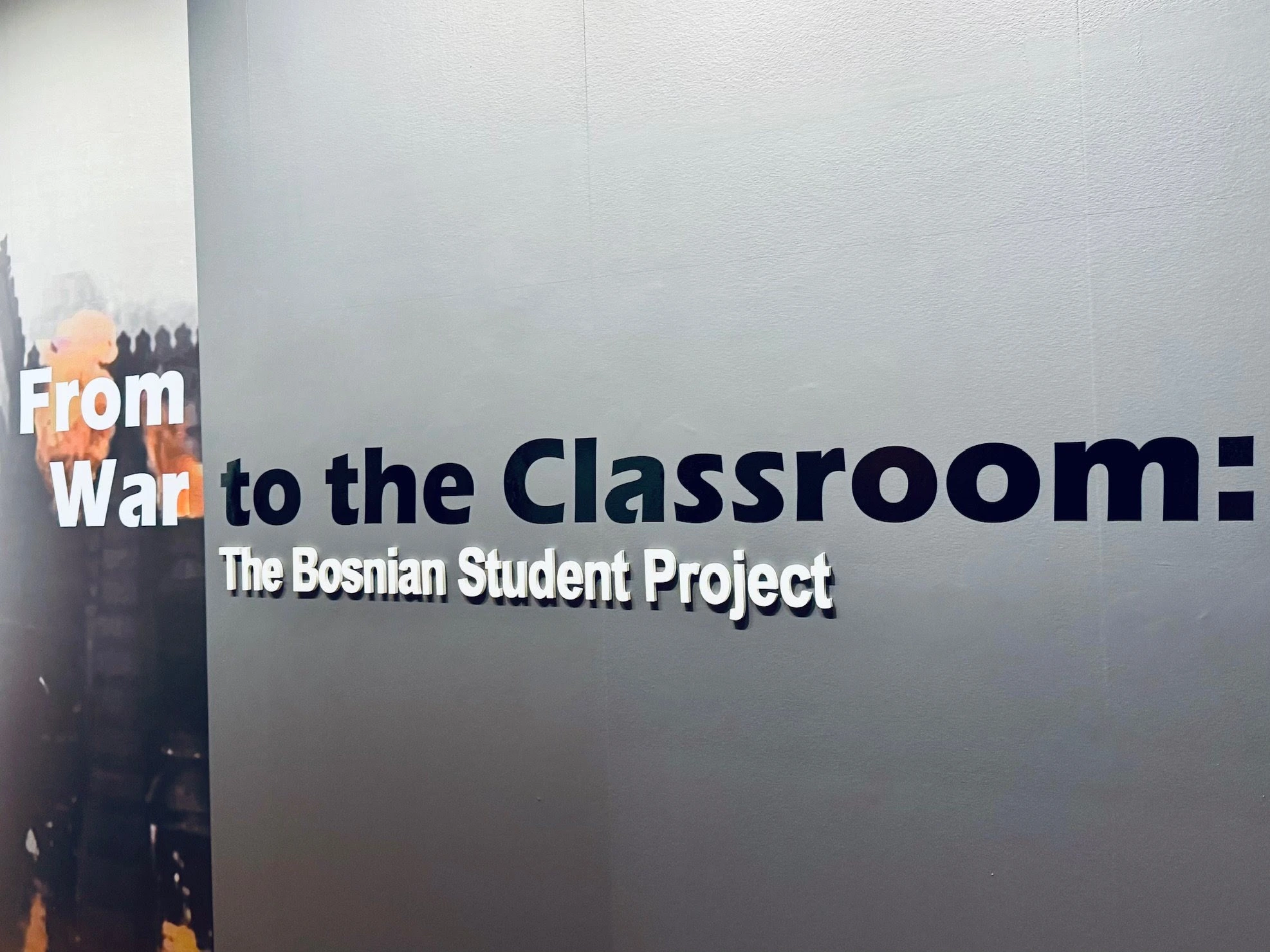

Last Friday’s gallery talk, “From War to the Classroom: Preserving Cultural and Social Memory in the Aftermath of War and Genocide,” brought together scholars, activists, survivors, and community members for a deeply moving conversation on the stakes of cultural preservation in Bosnia and Herzegovina. Hosted at the Saint Louis University Museum of Art, the event invited attendees to reflect on a powerful guiding question:
What are we willing to risk for the preservation of culture?
Moderated by longtime researcher and advocate Patrick McCarthy, the discussion featured Dr. Amila Buturović, scholar and writer; Doug Hostetter, activist and co-founder of the Bosnian Student Project (BSP); and Lejla Susić, BSP alumna and organizer. Together, they examined the meaning of memory, the deliberate destruction of cultural heritage during the 1992–1995 war, and the ongoing responsibility to resist erasure in the aftermath of genocide.
Cultural Heritage Under Attack
The speakers revisited some of the most devastating examples of cultural annihilation during the Bosnian war—acts meant not only to destroy buildings, but to fracture identity, memory, and continuity.
One such symbol was Stari Most, the 16th-century Ottoman bridge in Mostar and a UNESCO World Heritage site. After months of shelling, the bridge collapsed into the Neretva River in November 1993, becoming one of the most recognizable images of cultural destruction in Europe.
The conversation also highlighted the fate of Foča’s Aladža Mosque, built in 1549 and considered one of the finest examples of Ottoman architecture in the region. Dynamited in 1992 and later bulldozed into a parking lot, its destruction was part of a campaign that erased all 12 mosques in Foča. Across Bosnia and Herzegovina, 1,186 mosques were damaged or destroyed.
Perhaps the most searing loss was the August 1992 destruction of the National Library of Sarajevo, where incendiary grenades set off a fire that burned for three days. With water cut off to the city, firefighters and citizens could do little as 1.5 million books, manuscripts, and archival treasures were reduced to ash. The attack was a deliberate strike on Bosnia’s cultural and intellectual memory—an act of war meant to erase a people’s past.
Honoring Courage in the Face of Erasure
The gallery talk paid special tribute to Aida Buturović, the sister of Dr. Amila Buturović, who was killed in 1992 while attempting to save books from the burning National Library. Her bravery and devotion to knowledge became a powerful emotional center of the evening, reminding attendees of the human stories behind cultural preservation.
Celebrating the Bosnian Student Project
The event accompanied the exhibition “From War to Classroom: The Bosnian Student Project,” created for the 2025 BSP Reunion. The exhibit traces the journeys of the hundreds of students rescued through the BSP’s humanitarian effort, highlighting how education offered not only safety and opportunity, but a bridge from trauma to hope.
Featuring archival materials, maps, personal histories, and testimonies, the exhibit honors the interfaith activism and collective solidarity that shaped the program. It also emphasizes the necessity of preserving survivor voices so their experiences remain part of the global historical record.
Though the reunion has concluded, the exhibit remains open through December, giving visitors an opportunity to engage with this extraordinary chapter of international cooperation and resilience.
Extending the Conversation
Friday’s talk is part of a broader effort by the Center for Bosnian Studies at Saint Louis University to foster dialogue around peacebuilding, cultural preservation, and community memory in both Bosnia and its diaspora. Attendees were invited to stay engaged, continue learning, and support the ongoing work of safeguarding history from erasure.
A full 90-minute recording of the gallery talk is available for those who missed it or wish to revisit the discussion.
As the evening concluded, one message resonated clearly: preserving cultural memory is not only an act of remembrance—it is an act of resistance, responsibility, and hope. The commitment to protect Bosnia and Herzegovina’s heritage continues, driven by communities determined to ensure that truth endures.